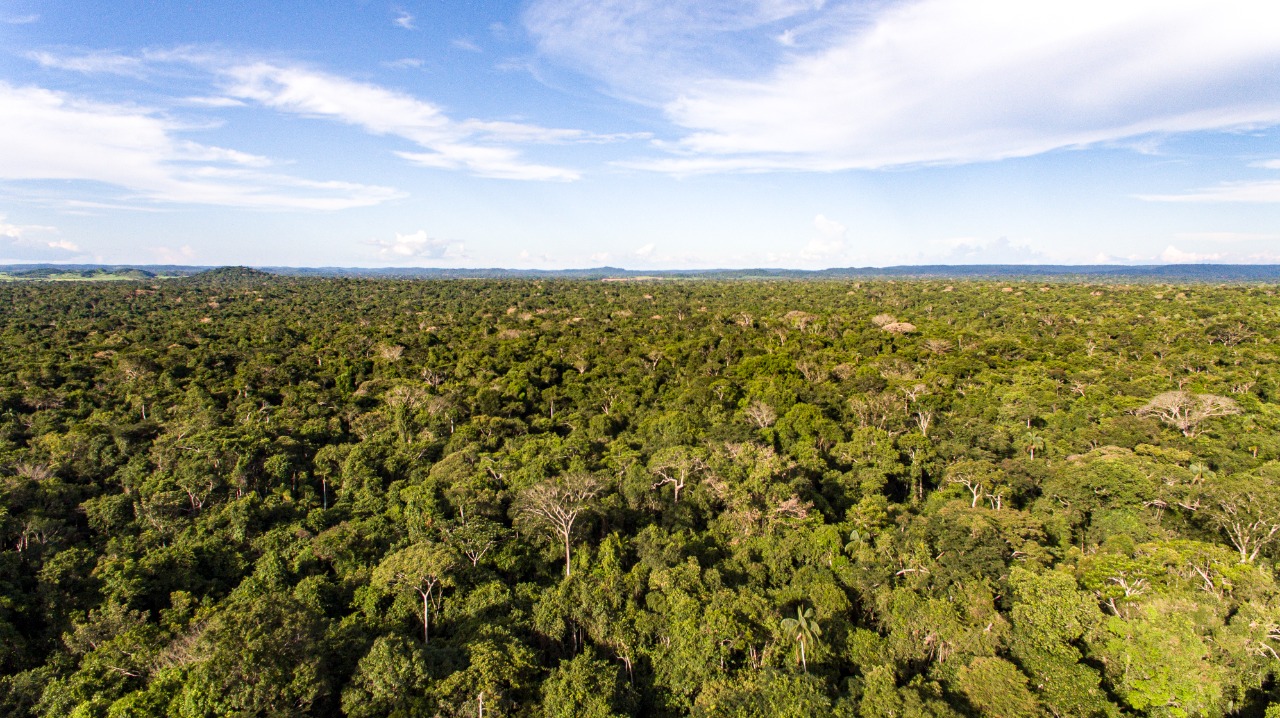
In March 2026, Brazil did something no government had done before in quite this way: it auctioned a 40-year restoration concession on a degraded national forest, with carbon credits as the explicit primary revenue source. re.green, a São Paulo-based ecological restoration company, won the rights to restore 59,000 hectares of the Bom Futuro National Forest in Rondônia.
A new approach to carbon finance for restoration
The Bom Futuro concession introduced a governance structure with no direct global predecessor. re.green will restore native vegetation on heavily degraded public land over four decades, generate verified carbon removal credits, and pay the Brazilian Forest Service a concession fee. That fee — 0.7% of carbon credit revenues, estimated in the auction notice at around $2 million annually — was set by the tender document and not competitively bid. Bidders competed only on the quality of their restoration and protection plan.
The state retains land ownership. The developer retains most of the upside. The government now creates a revenue stream from land that was generating nothing.
Bom Futuro is a pilot: authorities also plan to make about 750,000 acres available under this model by 2027. Additionally, 3.2 million acres of protected areas needing restoration have been mapped, showing that the challenge goes far beyond a single contract.
re.green was the sole bidder for this tender. At the time of the tender, re.green had 37,000 hectares under management, 20,000 hectares under active restoration, and had delivered 10 million seedlings through Bioflora, their in-house nursery operation. They had also won the Earthshot Prize in November 2025, a credible independent quality signal of their prowess in NbS. Bom Futuro is their first project on government-owned land, and CEO Thiago Picolo called this the ‘opening the federal restoration concession sector.’
The global precedent
Bom Futuro is the first-time competitive auction, protected-area national forest, restoration activity, and carbon-as-primary-revenue have appeared in combination. The closest precedents diverge on critical structural dimensions.
Indonesia has a long-standing forest concession system, newly anchored as Forest Utilization Business License (PBPH) under the Job Creation Law. These are application-based permits on state production forest, allowing various types of forest-based activities, including timber, non-timber forest produce and often, productive land conversion. Only recently has “environmental services”, which includes carbon project development, become a popular reason for applications.
In 2023, during the run-up to COP28, a Dubai-based company called Blue Carbon LLC signed a series of MoUs with Tanzania, Zambia, Liberia, Zimbabwe, Kenya, the Bahamas, Saint Lucia, Dominica, and Papua New Guinea. The deals covered a total area of 24.5 million hectares, with different structures of carbon revenue sharing mechanisms with governments and communities. These were negotiated deals or were merely expressions of interest, not tendered contracts. They have been mired in controversy and have no substantiated results. The deals have all “stalled”, according to an investigative report by Agence France-Presse.
Can Brazil’s model be taken up in the Global South?
The model can be summarized in one line: A government monetizes degraded public land by licensing restoration rights to a private developer, who funds and sells credits while paying a concession fee.
This opens up several parcels of state-owned land currently outside the carbon market universe. Many of them are facing degradation pressures, tightening public budgets, and outdated forest management models that can be addressed through additional carbon revenues and VCM’s latest forest management methodologies.
It requires three preconditions:
- a legal framework authorizing carbon rights within concessions,
- a pipeline of capitalized developers, and
- a concession fee low enough to attract bids at this experimental stage.
Brazil met the first condition in 2023, when both the Public Forests Management Act and the ICMBio Creation Act were amended to authorise carbon credit development within protected area concessions and explicitly allow ownership of credits to transfer from the state to the concessionaire. Indonesia has had unreliable policy stance; only recently did they lift an embargo on trading with the international voluntary market and several 2020-23 vintage REDD+ credits were issued by Verra. The DRC and Republic of Congo have enormous degraded public forest but lack the regulatory and carbon market governance infrastructure. Kenya has introduced a revenue-sharing requirement on public land carbon projects but no competitive tender mechanism. Colombia, Peru, and India have ARR carbon projects but they remain on private or community land.
Governments need to address long-term policy and regulatory uncertainty for this model to scale. The Bom Futuro auction had a second plot, which had no bidders. No reason has been given, but one can surmise that perceived risks for developers were too high. Specific to the fixed-fee design, governments capture no upside from improving carbon prices. A competitive revenue-share bid would have been a better instrument for the state.
For developers, public land removes land acquisition cost and delivers scale — but concentrates political and permanence risk into a single long-term counterparty relationship with a government. The 40-year dependency on policy continuity is not trivial. The model’s bankability also depends on a developer bringing institutional offtake to the table independently.
For investors watching this from the private-land ARR side, the dynamic is double-edged. If the Brazilian government scales public land concessions with a fixed fee model, developers bidding here have zero land acquisition cost. What does that do to the cost structure of the private-land ARR market, which is the current model for Amazon carbon projects? Public land supply at structurally lower capex could compress blended carbon prices in Brazilian ARR — a risk for investors who have priced private-land projects on current cost curves. Optimistically though, government-backed concessions open up land genuinely in need of restoration, and brings in clearer regulatory and legal mandates that allow for the long durations of restoration projects. Which effect dominates will depend on the pace and quality of what Brazil does next, and which country follows this model next.
Leave a Reply